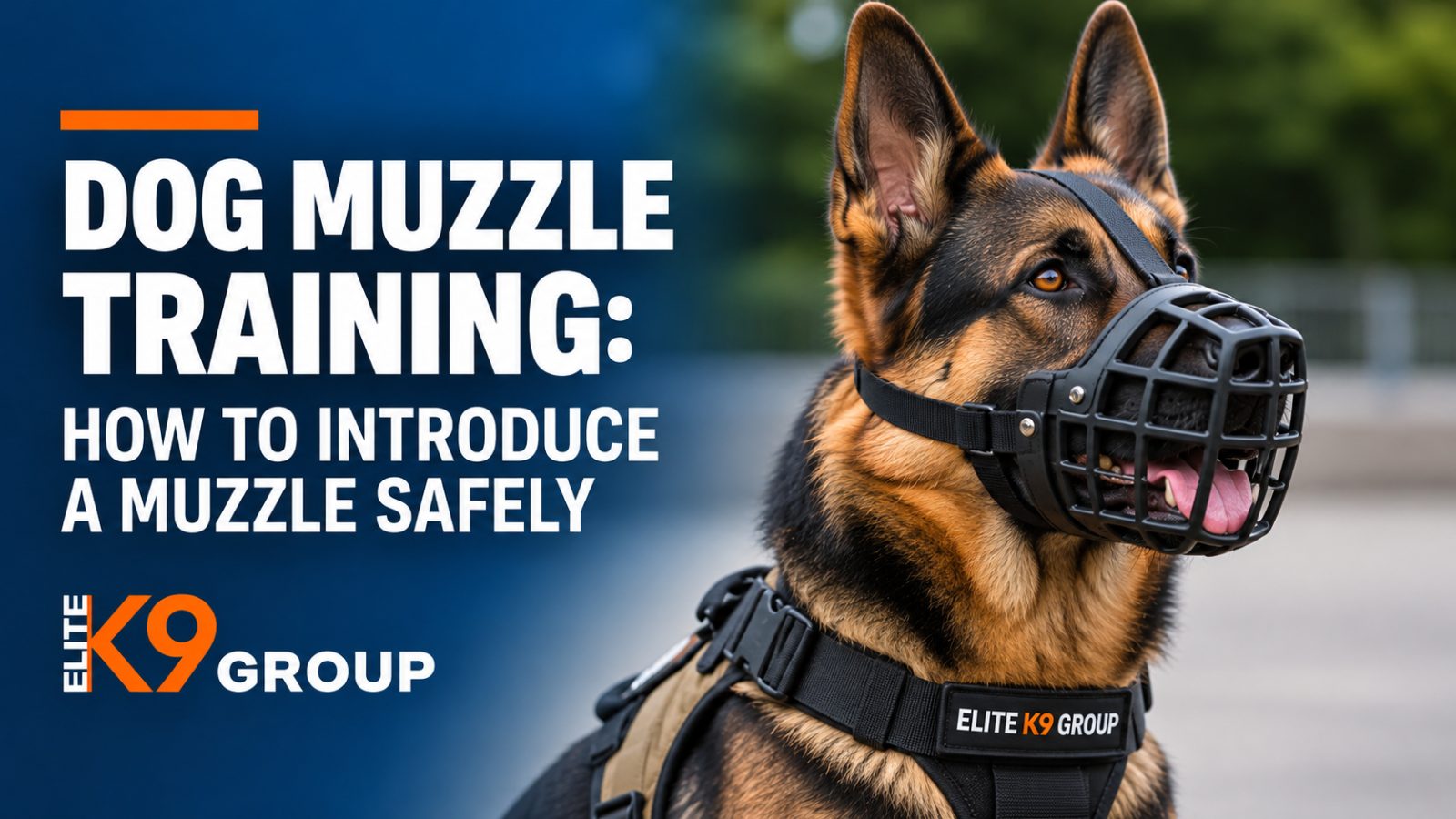
Does your dog pull away when you try to put on a muzzle? Maybe they paw at it, freeze, or refuse to let it near their face.
For many owners, the first experience with a muzzle happens during a stressful situation: a veterinary appointment, an injury, or a behavioral problem.
Unfortunately, introducing unfamiliar equipment when a dog is already frightened can make things more difficult.
That's why dog muzzle training is worth considering before a muzzle becomes necessary.
Despite common misconceptions, muzzles aren't exclusively for aggressive dogs. They can be useful safety tools during veterinary visits, grooming, and situations where additional precautions are needed.
AtElite K9 Group, we understand the importance of safe handling, clear communication, and professional training. A muzzle should never be treated as punishment. The goal is to help your dog accept it comfortably and voluntarily.
In this guide, we'll explain how to muzzle train a dog, choose appropriate equipment, avoid common mistakes, and recognize when professional support may help.
What Is Dog Muzzle Training?
Muzzle training is the gradual process of teaching a dog to accept and comfortably wear a properly fitted muzzle.
Instead of forcing the equipment onto the dog's face, owners introduce it through short, positive experiences.
Training usually begins with allowing the dog to investigate the muzzle and progresses toward voluntarily placing its nose inside.
Eventually, the dog learns to accept the straps and move comfortably while wearing it.
The goal isn't simply to make a dog wear a muzzle. It's to help the dog feel comfortable doing so.
Successful muzzle training requires patience, consistency, and attention to the individual dog's behavior.
Why Do Dogs Need Muzzles?
A muzzle doesn't automatically mean a dog is dangerous. Several situations may make one useful.
Veterinary Appointments
Even a normally friendly dog may react defensively when injured, frightened, or experiencing pain.
A properly fitted muzzle can provide additional protection during necessary veterinary procedures when biting is a concern.
Introducing one beforehand may make future appointments easier to manage.
Grooming and Handling
Some dogs become uncomfortable when their paws, ears, or sensitive areas are touched.
A muzzle may be recommended as part of a safety plan, but it shouldn't be used to force a frightened dog through unnecessary handling.
Fear, Reactivity, or Biting Concerns
Dogs that react intensely around unfamiliar people or animals may need additional precautions.
A muzzle can reduce certain biting risks, but it doesn't eliminate fear or aggression.
For dogs struggling with barking, lunging, or intense responses to triggers, our article onreactive dog training explains why understanding the cause of the behavior matters.
Preventing Dangerous Scavenging
Some dogs regularly pick up objects while walking.
Depending on its design, a suitable muzzle may help prevent access to certain harmful items.
However, no muzzle guarantees complete protection. Dogs that repeatedly eat non-food objects should also receive veterinary assessment.
Are Dog Muzzles Good for Training?
Dog muzzles can be useful during training, but they're safety equipment rather than a behavioral solution.
Consider a dog that becomes frightened whenever an unfamiliar person approaches.
A muzzle may reduce the risk of biting, but it doesn't change the dog's underlying emotional response.
The dog may still feel threatened.
Effective behavior modification involves identifying the cause and helping the dog develop more appropriate responses.
At Elite K9 Group, ourbehavioral modification training programs focus on evaluating individual behavioral challenges and developing suitable training approaches.
A muzzle may be one safety precaution, but appropriate supervision and management remain essential.
Choosing the Right Dog Muzzle
Before beginning training, select equipment that suits your dog's size, facial structure, and intended use.
An uncomfortable muzzle can undermine training and create unnecessary health risks.
Basket Muzzles
Basket muzzles are often preferred for positive muzzle training and appropriate supervised wear.
A properly fitted basket muzzle should allow your dog to:
- Open its mouth sufficiently to pant.
- Breathe comfortably.
- Drink water.
- Receive suitable treats.
- Move naturally without painful pressure.
Basket muzzles come in different materials and shapes.
For dogs with a serious bite history, choosing an appropriately secure, bite-resistant design is particularly important.
Soft or Fabric Muzzles
Soft muzzles often fit closely around the dog's mouth.
Some restrict panting, making them unsuitable for walks, exercise, or extended wear.
They may have limited uses during brief, professionally supervised procedures, but they shouldn't replace a suitable basket muzzle for routine training.
How Should a Muzzle Fit?
A properly fitted muzzle should remain secure without rubbing against the eyes, nose, or cheeks.
Your dog must have enough room to pant comfortably.
Because facial shapes differ, fit should be based on measurements rather than breed labels alone.
If you're unsure, consult a veterinarian or qualified behavior professional.
How to Muzzle Train a Dog: Step-by-Step
If you're wondering how to muzzle train a dog, begin when your dog is relaxed and comfortable.
Use small rewards, work in a familiar environment, and keep sessions short.
Step 1: Introduce the Muzzle
Place the muzzle on the floor or hold it at a comfortable distance.
Allow your dog to investigate voluntarily.
Reward calm interest without attempting to put the equipment on.
The first objective is simply to create a positive association.
Step 2: Encourage Your Dog to Approach
Hold the muzzle still with its opening facing your dog.
Reward voluntary movement toward it.
You can offer a treat near the entrance, allowing your dog to investigate without pressure.
If your dog moves away, give them space rather than following them with the muzzle.
Step 3: Teach Voluntary Nose Placement
Once your dog approaches confidently, encourage them to place their nose inside.
Offer a small reward through the opening.
Don't fasten the straps yet.
Allow your dog to withdraw freely and repeat until nose placement becomes comfortable.
Step 4: Increase the Duration
When your dog willingly places its nose inside, begin rewarding slightly longer periods.
Start with just a second or two.
Gradually increase the duration over several sessions.
If your dog becomes uncomfortable, return to shorter repetitions.
Progress should be measured by comfort, not by how quickly you can fasten the muzzle.
Step 5: Introduce the Straps
Some dogs accept the basket but become uncomfortable when straps move around their heads.
Practice touching and positioning the straps gently without fastening them.
You can also introduce the buckle sound separately and reward relaxed behavior.
Avoid sudden movements or unnecessary restraint.
Step 6: Fasten the Muzzle Briefly
When your dog accepts the previous steps, fasten the muzzle for a few seconds.
Reward them, then remove it.
Gradually extend the wearing time as your dog becomes comfortable.
If they freeze, panic, or repeatedly attempt to escape, stop safely and return to an easier stage.
Step 7: Practice Comfortable Movement
Once your dog can wear the muzzle calmly, introduce familiar activities.
Practice a simple obedience command or walk a few steps indoors.
Later, introduce other appropriate environments.
Your dog should remain supervised throughout.
How Long Does Muzzle Training Take?
There is no fixed timeline.
A confident dog without negative experiences may progress relatively quickly.
A fearful dog may need several weeks or longer.
Rather than focusing on a deadline, observe your dog's behavior.
Positive signs include voluntarily approaching the muzzle and remaining relaxed during handling.
Freezing, repeated avoidance, frantic pawing, or refusing normally appealing rewards suggest that training should slow down.
If distress continues, consider professional guidance.
Puppy Muzzle Training: Should You Start Early?
Some owners associate muzzles only with adult dogs that have behavioral problems.
However, puppy muzzle training can be useful preparation for future veterinary visits or unexpected situations.
Puppies can learn to investigate equipment, approach voluntarily, and receive rewards for calm behavior.
There's no reason to rush toward prolonged wear.
Because puppies grow quickly, muzzle fit must be checked frequently.
A muzzle that fits today may become restrictive as the puppy develops.
Puppy training should also include socialization, gentle handling, and foundational obedience.
For owners dealing with common mouthing or nipping, our guide onhow to stop puppy biting explains why these behaviors should be addressed through appropriate training rather than automatically relying on a muzzle.
What if Your Dog Is Afraid of the Muzzle?
Some dogs become nervous as soon as the muzzle appears.
Others accept the basket but panic when the straps are fastened.
These reactions shouldn't be ignored.
If your dog repeatedly backs away, return to a stage where they feel comfortable.
For example, place the muzzle at a distance and reward calm observation without requiring contact.
Gradually encourage closer interaction over multiple sessions.
A dog that becomes unusually still isn't necessarily relaxed. Freezing can indicate significant stress.
For dogs with serious handling sensitivity or a bite history, seek qualified professional guidance rather than attempting potentially dangerous exercises independently.
Common Muzzle Training Mistakes
Even appropriate equipment can become stressful when introduced incorrectly.
Forcing the muzzle on: Physical pressure can increase fear and create negative associations.
Choosing the wrong size: Poor fit may cause rubbing, pain, or difficulty panting.
Moving too quickly: Some dogs need additional time before accepting nose placement or strap handling.
Using a muzzle as punishment: Muzzles shouldn't be used to punish barking, jumping, or unwanted behavior.
Leaving a dog unattended: Equipment can shift, become caught, or cause injury. Dogs wearing muzzles require supervision.
Assuming every interaction is safe: A muzzled dog can still lunge, collide with people, and experience distress.
Avoiding these mistakes makes training safer and more comfortable.
Does Muzzle Training Work for Aggressive Dogs?
Muzzle training can be especially useful when a dog has displayed biting behavior.
However, wearing a muzzle isn't the same as overcoming aggression.
For example, a dog that growls when strangers approach may still feel frightened while wearing one.
The muzzle may provide protection, but the underlying emotion remains.
Dogs can display aggression because of fear, pain, resource guarding, or other factors.
Different causes require different training approaches.
Our guide onhow to stop dog aggression explains why identifying triggers and managing risk are important before beginning behavior modification.
For serious biting concerns, professional behavioral assessment is essential.
A veterinarian may also need to evaluate medical factors contributing to the behavior.
Can Muzzle Training Improve Obedience?
Muzzle training isn't an obedience program, but it involves useful learning principles.
Dogs practice responding to predictable cues and participating in structured exercises.
Owners learn to recognize body language, reinforce desirable behavior, and adjust training difficulty.
These skills apply to other training activities.
However, accepting a muzzle doesn't automatically mean a dog will respond reliably to commands.
Recall, leash manners, impulse control, and everyday obedience must be developed separately.
Elite K9 Group'sdog obedience training programs focus on practical command responses and control in real-world environments.
When Should You Seek Professional Help?
Many owners can introduce a muzzle through gradual home training.
However, professional guidance is especially valuable when a dog:
- Has bitten or attempted to bite someone.
- Becomes defensive when its face is touched.
- Panics when the muzzle is presented.
- Has persistent fear or reactivity.
- Cannot tolerate necessary handling.
- Requires a muzzle as part of a broader behavior-management plan.
A professional assessment can help identify why the dog is struggling and determine suitable next steps.
At Elite K9 Group, our training process focuses on understanding the individual dog's behavior and developing practical training goals.
Depending on the situation, obedience training, behavioral modification, or additional specialist support may be appropriate.
The objective is safer handling and improved communication rather than simply suppressing visible behavior.
Frequently Asked Questions About Dog Muzzle Training
How Do You Muzzle Train a Dog?
Begin by allowing your dog to investigate a suitable muzzle voluntarily. Reward calm interest, gradually encourage nose placement, introduce the straps separately, and increase wearing time only when the dog remains comfortable.
Are Dog Muzzles Good for Training?
They can be useful safety tools, especially during appropriately managed behavior training. However, muzzles cannot replace obedience training or behavior modification.
Does Muzzle Training Work?
Many dogs can learn to accept a properly fitted muzzle through gradual, reward-based training. Progress depends on their temperament and previous experiences.
Is It Cruel to Put a Muzzle on a Dog?
A suitable muzzle introduced humanely is not inherently cruel. However, poor fit, unnecessary restraint, and restrictive designs can cause distress or create safety concerns.
Can a Muzzle Stop a Dog From Barking?
A muzzle shouldn't be used to prevent barking. Designs that restrict normal panting can be unsafe. Barking should be addressed by identifying its cause.
Can Puppies Wear Muzzles?
Yes. Puppies can learn to accept appropriately fitted muzzles through gentle, positive familiarization. Their changing facial dimensions require regular fit checks.
Does a Muzzle Make an Aggressive Dog Safe?
No. A suitable muzzle may reduce bite risk, but it doesn't eliminate aggression, lunging, or other potentially dangerous behavior. Supervision and appropriate management remain necessary.
Safer Handling Starts With Understanding Your Dog
A muzzle can be a valuable safety tool, but the way it's introduced matters.
Effective dog muzzle training requires suitable equipment, patience, positive reinforcement, and respect for your dog's comfort.
Some dogs become comfortable quickly. Others need additional time and guidance.
When muzzle use is connected to aggression, fear, or reactivity, the underlying behavior should be addressed alongside immediate safety concerns.
At Elite K9 Group, we help owners explore professional obedience and behavioral training options based on their dogs' individual needs.
If your dog struggles with handling, fearful reactions, or challenging behavior, our team can help you determine an appropriate next step.
Schedule a free consultation with Elite K9 Group to discuss your dog's behavior and training needs.
Elite K9 Group 13238 Riverside Dr Sherman Oaks, CA 91423