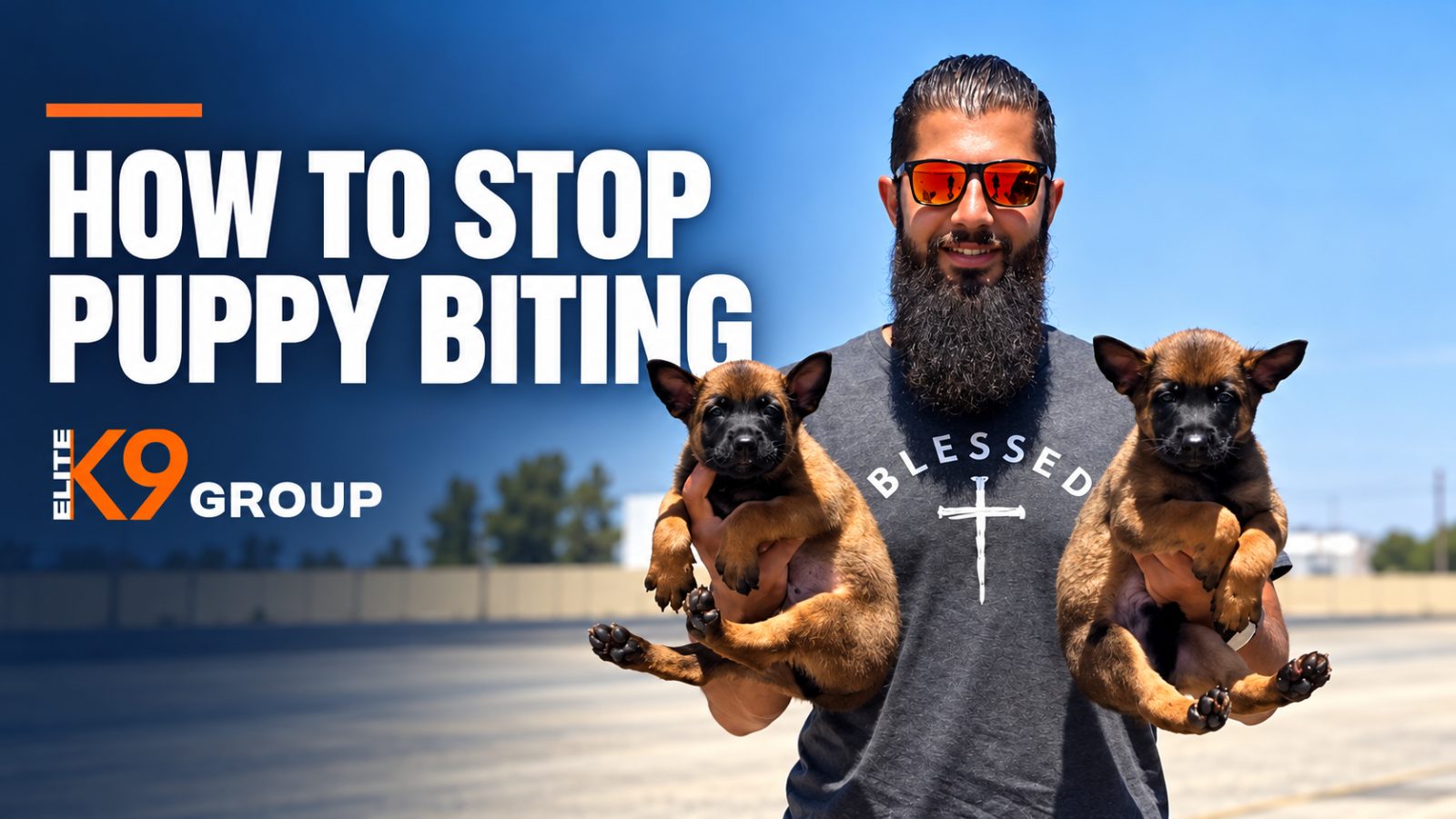
At Elite K9 Group, we believe every puppy deserves the right start in life. We care about helping puppies develop good habits, build confidence, and learn appropriate behavior from an early age. We also understand that raising a puppy comes with challenges, and one of the most common is biting and nipping.
Puppy biting is a natural part of development, but without clear guidance and consistent boundaries, it can quickly become frustrating for owners.
That's why our team at Elite K9 Group in Sherman Oaks, Los Angeles, has prepared this guide on how to stop puppy biting. We'll explain why puppies bite, what owners can do to manage the behavior, and how professional puppy training can help establish better habits from the beginning.
Why Do Puppies Bite So Much?
If your puppy constantly bites your hands, grabs your clothes, or nips at your ankles, you're probably wondering why it happens.
Puppies explore the world using their mouths. Biting and mouthing are part of how they play, communicate, and learn about their surroundings. However, several factors can contribute to excessive puppy biting.
Teething and Discomfort
As puppies develop, their baby teeth are replaced by permanent teeth. Chewing can help relieve some of the discomfort associated with teething, making hands, furniture, and other objects tempting targets.
Excitement and Play
Puppies often use their mouths during play. When they're excited, they may bite hands, tug at sleeves, or chase moving feet without understanding that their sharp teeth can hurt.
Overstimulation and Tiredness
An overtired puppy may become unusually energetic, restless, and mouthy. Too much activity, constant attention, or insufficient rest can make biting more difficult to manage.
Learning Social Boundaries
Puppies are still developing an understanding of appropriate interactions. They need guidance to learn which behaviors are acceptable and how to play without hurting people.
Because puppy biting can have different causes, the same response won't necessarily work for every puppy. Professional trainers can help identify contributing factors and guide owners toward appropriate training strategies.
How to Stop Puppy Biting: What Owners Should Know First
If you're trying to figure out how to get your puppy to stop biting, there are a few things you can begin doing at home.
These strategies can help manage everyday mouthing, but persistent or difficult behavior may benefit from an individualized professional training plan.
1. Redirect Biting Toward Appropriate Toys
When your puppy begins biting your hands or clothing, calmly offer an appropriate chew toy instead.
Choose toys designed for puppies and suitable for their size and chewing habits. When your puppy engages with the toy, reinforce that choice with attention or praise.
This helps them learn what they are allowed to chew without turning the interaction into a struggle.
2. Reward Calm and Gentle Behavior
Pay attention to moments when your puppy interacts appropriately.
If your puppy approaches without nipping, plays gently, or settles calmly, reward that behavior.
Consistently reinforcing appropriate interactions helps puppies understand which behaviors are worth repeating.
3. Avoid Rough Play With Your Hands
Wrestling with your puppy using your hands may unintentionally encourage biting fingers and arms.
Instead, use suitable toys to create separation between your hands and your puppy's mouth. If play becomes too rough, calmly pause the interaction and resume once your puppy has settled.
4. Recognize When Your Puppy Needs Rest
If your puppy becomes increasingly mouthy after a long play session, they may need a break.
Provide opportunities for rest in a comfortable, quiet environment. Consistent daily routines involving sleep, feeding, appropriate exercise, and enrichment can also help manage overstimulation.
5. Keep Household Rules Consistent
Puppies can become confused when one family member encourages rough play while another discourages it.
Everyone in the household should follow similar expectations for playing, redirecting biting, and rewarding gentle behavior.
If you've recently welcomed a puppy into your family, our guide to bringing a new puppy home offers additional advice on establishing early routines.
These first steps are useful, but understanding when and how to apply them can be challenging. This is where professional puppy training can provide additional support.
Why Professional Puppy Training Can Make a Difference
Puppy biting is common, but that doesn't mean owners have to navigate every training challenge alone.
Working with experienced professionals can help you understand your puppy's behavior, establish consistent expectations, and develop a training approach suited to their individual needs.
Understanding Why Your Puppy Bites
Not every puppy bites for the same reason.
One puppy may nip when excited, while another may bite during teething, frustration, or uncomfortable interactions.
A professional evaluation can help identify patterns in your puppy's behavior and determine which training strategies may be appropriate.
At Elite K9 Group, our training approach begins with understanding the individual dog rather than assuming every behavioral challenge has the same cause.
Teaching Bite Inhibition and Appropriate Play
One of the most important parts of early puppy development is bite inhibition.
Bite inhibition refers to a dog's ability to control the force of its mouth during interactions.
Puppies don't automatically understand how sensitive human skin is. They need opportunities to learn appropriate boundaries and gentler ways to interact.
Professional training can help owners understand how to reinforce gentle behavior, redirect unwanted mouthing, and create consistent responses to inappropriate biting.
The goal isn't to prevent puppies from ever using their mouths. It's to help them develop appropriate habits and safer interactions.
Elite K9 Group includes bite inhibition in its professional puppy training program, alongside socialization and early obedience foundations.
Establishing Good Habits Early
Puppy training is about more than addressing one unwanted behavior.
Learning simple commands, practicing calm interactions, and developing communication can support better behavior in everyday situations.
For example, teaching a puppy to respond to their name or follow a simple cue can make it easier to redirect their attention during play.
Our guide to basic puppy training commands explains several useful foundations for young dogs.
Professional guidance can help owners understand which skills to prioritize and how to build on them as their puppy develops.
Building Confidence Through Proper Socialization
Early socialization can play an important role in helping puppies become comfortable with different people, environments, sounds, and everyday experiences.
However, socialization isn't simply about introducing a puppy to as many people or dogs as possible.
Experiences should be appropriate for the puppy's age, health, and comfort level. Pushing a fearful or overwhelmed puppy into unfamiliar situations can be counterproductive.
A professional can guide owners in creating manageable, positive experiences while respecting the puppy's individual needs.
Helping Owners Understand Their Puppies
Professional training works best when owners understand how to reinforce what their puppies are learning.
A trainer can demonstrate appropriate responses to unwanted behavior, explain common mistakes, and help household members remain consistent.
This guidance can be especially valuable for first-time puppy owners who are unsure whether their puppy's biting is normal or requires additional attention.
The objective is to build a stronger relationship between the puppy and its owner, with clear communication and practical skills that continue beyond training sessions.
Common Mistakes That Can Make Puppy Biting Worse
Sometimes, the way people respond to biting can unintentionally encourage it.
Here are several common mistakes to avoid.
Encouraging biting during play. Allowing puppies to wrestle with hands may teach them that human skin is an appropriate play target. Use toys to encourage different play habits.
Responding inconsistently. If biting receives different reactions every day, your puppy may struggle to understand the expectations. Establish consistent household rules.
Using harsh corrections. Hitting, shouting, or intimidating a puppy can increase fear and stress. Calm redirection and reinforcement of appropriate behavior are safer approaches.
Ignoring the need for rest. An overtired puppy may become harder to manage. Regular rest periods and predictable routines can help.
Assuming every bite is aggression. Normal play biting and fear-related behavior are not the same. Look at the puppy's overall behavior and the circumstances.
If the biting is becoming more frequent, intense, or difficult to interrupt, a professional can help determine whether additional training or behavioral assessment is appropriate.
When Do Puppies Stop Biting?
One of the most common questions puppy owners ask is when they can expect the biting stage to end.
Puppies typically begin losing their baby teeth around three to four months of age, and most have their permanent teeth by approximately six to seven months.
As teething discomfort decreases, some chewing and mouthing behaviors may also become less frequent.
However, not all puppy biting is caused by teething.
If a puppy has learned that biting hands leads to play, attention, or exciting reactions, that behavior may continue after teething ends.
This is why early training and consistent guidance matter.
Rather than waiting for every biting habit to disappear naturally, owners can begin establishing appropriate behavior while their puppies are still learning.
Professional puppy training can help families navigate these developmental stages with realistic expectations.
Is Puppy Biting Normal or a Sign of Aggression?
Most puppy mouthing and playful nipping are normal developmental behaviors.
However, it's important to pay attention to the circumstances in which biting occurs.
A puppy that bites during excited play may have a loose, energetic body posture and readily redirect toward a toy.
More concerning situations may involve intense fear, persistent guarding, freezing, rigid body posture, or biting that escalates when someone approaches or handles the puppy.
No single signal is enough to diagnose aggression. Behavior must be considered in context.
Our article about understanding dog body language explains how to recognize different communication signals.
If your puppy suddenly begins biting unusually hard, reacts painfully to touch, or shows an abrupt behavioral change, consult a veterinarian to rule out possible medical causes.
For persistent fear-related biting or other concerning behavior, seek assessment from a qualified behavior professional.
Elite K9 Group also offers behavioral modification training for dogs experiencing challenges such as fear, reactivity, and other behavioral concerns.
Early assessment can help owners better understand the problem and identify appropriate next steps.
Why Choose Elite K9 Group for Puppy Training in Los Angeles?
Finding the right professional guidance early in your puppy's development can make a meaningful difference in how you approach training.
At Elite K9 Group, we understand that puppies have different temperaments, learning experiences, and behavioral needs. That's why our training process emphasizes understanding the individual dog before determining the appropriate approach.
Based in Sherman Oaks, California, we offer professional dog training services for owners throughout Los Angeles and surrounding communities, including Studio City, Encino, Burbank, and the San Fernando Valley.
Our Puppy Training program focuses on important early-development skills, including bite inhibition, socialization, environmental exposure, and foundations for future obedience.
These skills help support more appropriate interactions, clearer communication, and better everyday routines.
We also recognize that puppy training involves the owner. Building consistent habits at home is an essential part of helping a puppy apply what they're learning.
Whether you're dealing with constant puppy nipping, difficulty managing excitement, or uncertainty about your puppy's behavior, professional guidance can help you identify suitable next steps.
If you're looking for a dog trainer in Sherman Oaks, our team can discuss your puppy's development and help you explore available training options.
Request a Free Puppy Training Consultation to get started.
You can also follow Elite K9 Group on Instagram for dog training content and updates from our team.
Frequently Asked Questions About Puppy Biting
How Do You Get a Puppy to Stop Biting?
Start by redirecting biting toward appropriate chew toys, rewarding gentle behavior, and keeping play interactions consistent. Make sure your puppy gets adequate rest and isn't becoming overstimulated. If the behavior is difficult to manage, professional puppy training can help you understand the cause and develop a suitable approach.
Is It Normal for an 8-Week-Old Puppy to Bite?
Yes. Mouthing and nipping are common in young puppies as they explore, play, and learn social boundaries. At eight weeks, puppies are still developing appropriate bite control. Gentle guidance and positive experiences are important at this stage. Seek professional advice if biting appears unusually intense or associated with significant fear or distress.
Why Does My Puppy Bite My Hands and Feet?
Hands and feet move frequently, making them interesting targets during play. Puppies may also bite because they're excited, teething, or seeking interaction. Redirecting their attention toward toys, avoiding rough hand play, and reinforcing calmer behavior can help. Persistent biting may benefit from professional assessment and training guidance.
Can a Professional Dog Trainer Help With Puppy Biting?
Yes. A professional trainer can assess your puppy's behavior, help identify triggers, teach appropriate bite-inhibition exercises, and guide you in responding consistently. Early puppy training can also address related skills such as socialization, basic obedience, and managing excitement, giving owners a broader foundation for everyday behavior.
When Should I Take My Puppy to a Professional Trainer?
You can begin seeking appropriate puppy-training guidance early rather than waiting for biting to become a major problem. Professional instruction can help establish good habits from the beginning. If your puppy shows persistent fear-related biting, guarding, or unusually intense reactions, seek individualized advice promptly from a suitably qualified professional.
Does Puppy Biting Mean My Dog Will Become Aggressive?
No. Normal puppy mouthing and playful nipping do not automatically indicate future aggression. Many puppies bite as part of ordinary development. However, behavior associated with significant fear, pain, or repeated threatening responses deserves closer attention. Understanding the context and seeking appropriate guidance can help owners respond effectively.
Give Your Puppy the Right Start With Elite K9 Group
Puppy biting can be challenging, but it is also an opportunity to begin teaching important communication and behavioral skills.
With consistent guidance, appropriate expectations, and early training, puppies can learn healthier ways to play and interact.
You don't have to figure out every training challenge on your own. Professional guidance can help you understand your puppy's individual needs and build a foundation for better behavior as they grow.
At Elite K9 Group, we care about helping puppies and their owners develop confidence, communication, and good everyday habits.
If you're dealing with puppy biting or want to establish the right training foundations from the beginning, our team in Sherman Oaks is here to help you explore your options.
Book Your Free Behavior Consultation With Elite K9 Group and take the next step toward a better start for your puppy.