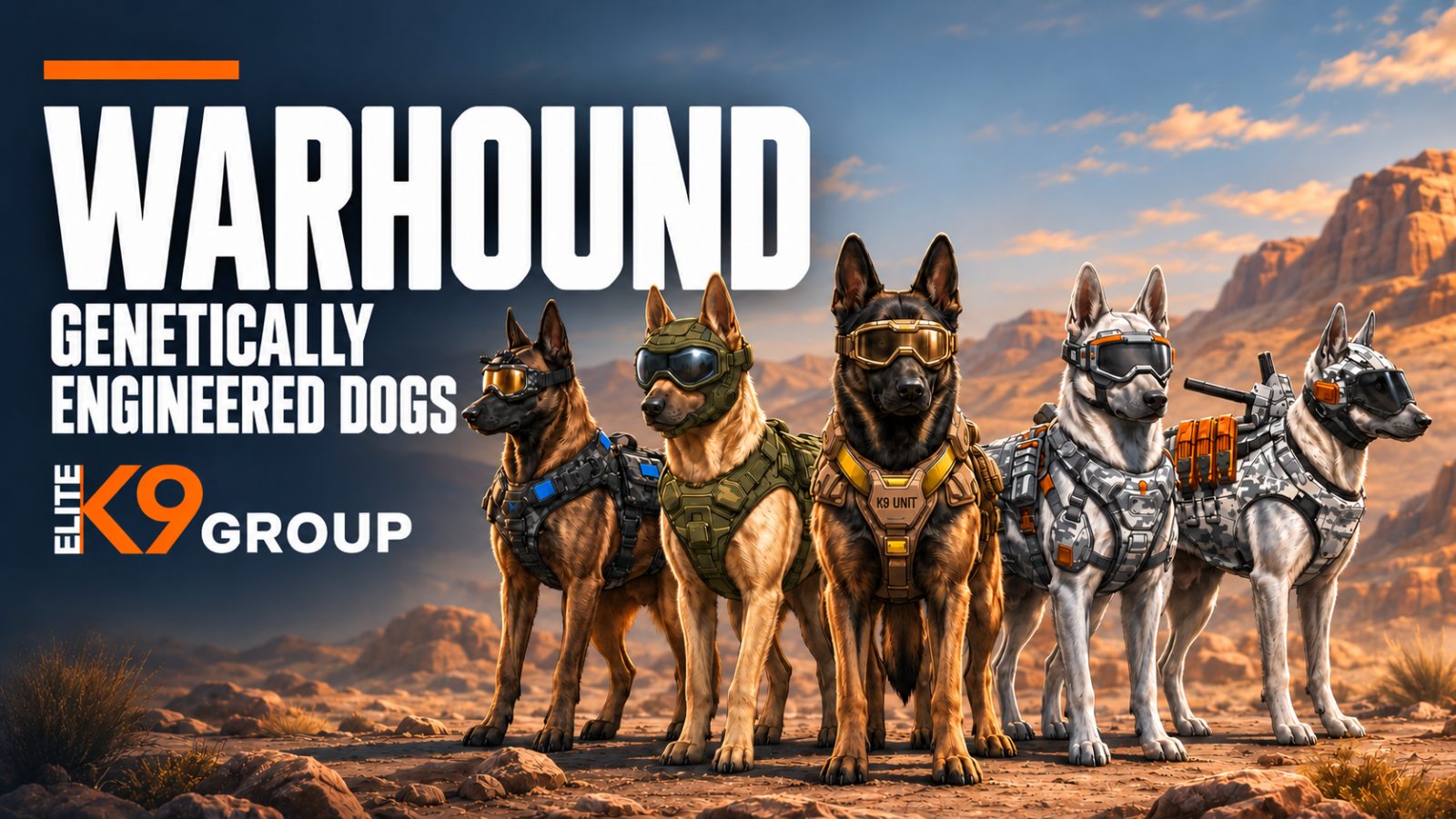
What if the next generation of military working dogs could benefit from genetic engineering, advanced protective equipment, and modern biotechnology?
That is the ambitious idea behind Warhound, an American defense technology startup that launched in October 2026 with $200 million in funding.
The company aims to transform how the United States develops and protects its military working dogs. By combining genetics, cloning, advanced technology, and professional training, Warhound hopes to produce healthier, more capable dogs for military personnel, law enforcement, and emergency responders.
What makes this project especially interesting is its focus on strengthening America's domestic working-dog supply while bringing together technologies developed by American companies.
At Elite K9 Group, we recognize the importance of proper working-dog selection, natural ability, and professional preparation. Warhound represents an exciting development in an industry where a dog's health, temperament, and training can make an extraordinary difference.
But can genetic engineering create a reliable working dog without traditional training?
What Is Warhound?
Warhound is a Texas-based defense technology company focused on developing the next generation of American military working dogs.
Launched on October 22, 2026, the company announced a $200 million seed funding round to support its research and development.
The Warhound startup plans to combine several technologies:
- Genetic research: Studying the characteristics of exceptional working dogs.
- Dog cloning: Preserving valuable genetic backgrounds from proven working animals.
- Gene editing: Investigating ways to reduce inherited health risks and potentially improve working capabilities.
- Defense technology: Developing advanced protective equipment and systems for dogs and handlers.
- Professional training: Preparing dogs for demanding assignments through structured programs.
Rather than treating these areas separately, Warhound intends to develop an integrated system for producing, training, and supporting working dogs.
Although many of its proposed technologies remain under development, the company's approach represents an ambitious application of American innovation.
Why Warhound Is Important for America
One of Warhound's main objectives is to strengthen the United States' ability to produce its own military working dogs.
According to the company's launch announcement, more than 80% of American military working dogs are acquired from Europe.
European working-dog breeding programs have a respected history, but depending heavily on international suppliers can create challenges involving availability, transportation, and long-term supply.
Warhound hopes to address these concerns by developing a stronger domestic program.
Building an American Working-Dog Supply
By combining biotechnology, breeding, veterinary care, and training within the United States, Warhound aims to reduce dependence on overseas suppliers.
A successful domestic program could create opportunities for American researchers, veterinarians, trainers, and working-dog specialists.
It could also help military and law-enforcement organizations access dogs selected for their specific operational requirements.
Combining American Technologies
Two prominent American technology companies are connected to Warhound's development.
Colossal Biosciences contributes biotechnology expertise, while Anduril Industries is involved through a defense technology partnership.
Together, these approaches could help modernize how working dogs are bred, equipped, and supported.
The potential to build a more reliable American working-dog program is one of Warhound's most promising goals.
Ben Lamm and Palmer Luckey: The People Behind Warhound
The Warhound concept originated with American technology entrepreneurs Ben Lamm and Palmer Luckey.
Ben Lamm and Colossal Biosciences
Ben Lamm is the co-founder and CEO of Colossal Biosciences, a biotechnology company researching genetics, cloning, and animal biology.
Colossal's technology is central to Warhound's proposed approach.
By studying the genetic material of exceptional working dogs, researchers hope to better understand inherited characteristics associated with health and working potential.
The goal is to improve breeding consistency and investigate ways to reduce particular inherited medical risks.
Palmer Luckey and Anduril Industries
Palmer Luckey is the founder of Anduril Industries, an American company developing advanced defense technology.
Luckey helped conceive Warhound's concept alongside Lamm, while Anduril is participating through a technology partnership.
Its proposed equipment could help improve protection, communication, and situational awareness for working dogs and their handlers.
Luckey is not an equity owner of Warhound, and neither entrepreneur manages its everyday operations.
Who Leads the Company?
Warhound is led by David Spirk, a former U.S. Marine and senior Department of Defense official.
His background connects the company's technological ambitions with the practical requirements of military operations.
How Warhound Plans to Use Genetic Engineering
Genetics is one of the most interesting aspects of Warhound's strategy.
Traditional working-dog breeding relies on selecting animals with desirable physical and behavioral characteristics.
Warhound intends to build on that approach using modern genetic research, cloning, and gene editing.
Identifying Exceptional Working Dogs
The company has collected genetic material from high-performing military, police, and emergency-response dogs.
These animals may possess valuable characteristics involving physical ability, working motivation, or suitability for specialized assignments.
Studying their genetic backgrounds could help researchers better understand which inherited factors contribute to working potential.
Dog Cloning: Preserving Valuable Genetics
Dog cloning is another important part of the project.
Cloning involves creating an animal with a genetic background closely matching that of an existing dog.
Warhound plans to use this technology to preserve valuable genetics from exceptional working animals.
For example, a Belgian Malinois with a successful working history could provide genetic material for future cloning research.
However, cloning does not reproduce a dog's memories, experiences, or training.
A cloned dog must still develop its own behavior, undergo socialization, and learn to work with a handler.
The potential benefit is a more predictable genetic starting point, not an automatically trained animal.
Gene Editing and Canine Health
Warhound is also investigating gene editing to address inherited health concerns.
Working dogs regularly perform physically demanding tasks requiring mobility, endurance, and concentration.
Reducing certain genetic health risks could potentially improve their quality of life and working longevity.
The company has also discussed longer-term possibilities involving sensory abilities, including scent detection.
However, complex characteristics are influenced by multiple genes and environmental factors. Their improvement cannot be guaranteed through a single genetic modification.
The effectiveness and long-term safety of Warhound's proposed genetic enhancements still need scientific evaluation.
Are Dogs Genetically Modified?
Dogs have been shaped through selective breeding for thousands of years, producing breeds with different physical characteristics and working abilities.
Modern genetic engineering is different.
Genetically engineered dogs have had particular genetic sequences deliberately modified through biotechnology rather than solely inheriting characteristics through conventional breeding.
How Are Dogs Genetically Modified?
Modern gene-editing techniques allow researchers to target specific regions of DNA.
Scientists can investigate these methods to study inherited diseases or biological characteristics.
Warhound hopes to apply such research to military working dogs, initially focusing on genetic health and potentially expanding into other characteristics.
The technology is promising, but genetics alone cannot guarantee superior health, temperament, intelligence, or performance.
Responsible breeding, veterinary care, socialization, and training remain essential.
Which Breeds Will Warhound Work With?
Warhound's initial plans focus primarily on three breeds with established histories in professional working roles.
Belgian Malinois
Belgian Malinois are known for their athletic ability, energy, responsiveness, and strong working motivation.
Appropriately selected individuals can excel in demanding professional assignments, but they require knowledgeable handling and consistent preparation.
German Shepherds
German Shepherds have a long history in military, police, detection, and protection work.
Their versatility and trainability make them valuable candidates for different roles.
Individual temperament, health, and training remain important factors in determining suitability.
Labrador Retrievers
Labrador Retrievers are widely associated with detection and specialized scent-based assignments.
Their motivation and trainability make them useful for certain professional applications.
By studying different breeds, Warhound hopes to better understand how inherited characteristics relate to working-dog performance.
Ultimately, successful selection depends on the individual dog and the assignment it must perform.
Advanced American Defense Technology for Working Dogs
Warhound's ambitions extend beyond biotechnology.
Through its partnership with Anduril, the company plans to introduce technology designed to improve working-dog safety and operational support.
According toWIRED's reporting on Warhound, the proposed technology primarily involves external equipment rather than robotic implants.
Potential applications include protective body armor, specialized equipment, and connected systems that provide additional information to handlers.
For dogs operating in dangerous environments, improved protection could be valuable.
Similarly, technology that strengthens communication and situational awareness may help handlers make better-informed decisions.
However, equipment must remain comfortable, practical, and suitable for the animal's natural movement and senses.
The underlying idea is encouraging: American defense technology could potentially help protect the dogs that already perform important and dangerous work alongside people.
Animal Welfare and Lifelong Care
One positive aspect of Warhound's announcement is its stated commitment to animal welfare.
The company plans to work under the guidance of the American Humane Society, which is expected to support training-program certification and retirement-related initiatives.
This matters because responsible working-dog development extends beyond breeding and performance.
Dogs require appropriate veterinary care, humane training, rest, and ongoing support throughout their lives.
Warhound has also discussed programs that could help retired military dogs reunite with former handlers or transition into suitable homes.
These commitments will need to be demonstrated as the program develops, but including animal welfare in the project's initial plans is an encouraging step.
If future biotechnology can help reduce health risks while maintaining appropriate welfare standards, the benefits could extend beyond operational performance.
Can Genetics Replace Professional Dog Training?
Warhound's technology may eventually improve how working dogs are bred, selected, and protected.
However, even genetically modified dogs will still need professional training.
Genetics may influence a dog's physical abilities and natural characteristics, but it cannot teach obedience, communication, or reliable working behavior.
Genetics Creates Potential. Training Develops It.
A dog may inherit exceptional athletic ability, motivation, or sensory characteristics.
But natural potential is not the same as professional preparation.
A powerful dog still needs impulse control.
A dog with excellent scent detection ability still needs specialized training to perform detection tasks.
And a naturally confident dog must learn how to respond appropriately in different environments.
Professional training develops these natural characteristics into practical skills.
Obedience Remains Essential
Reliable obedience is fundamental to working-dog performance.
Dogs must learn to respond consistently to their handlers, remain focused, and behave appropriately during challenging situations.
This requires structured learning, clear communication, and repeated practice.
The same principle applies to professional protection dogs.
A dog that displays uncontrolled aggression is not necessarily capable of responsible protection work.
Appropriate protective behavior requires stability, responsiveness, and reliable control.
Socialization and Temperament Matter
Genetic engineering cannot automatically guarantee a stable temperament.
A dog's behavior develops through a combination of inherited characteristics, environment, experiences, and training.
Even future Warhound military dogs would need carefully planned socialization and exposure to different situations.
They must learn to work around unfamiliar people, environments, equipment, and distractions.
The Dog-Handler Relationship Cannot Be Engineered
One of the most important elements of professional working-dog training is the relationship between the dog and its handler.
Reliable communication develops through consistency, experience, and mutual understanding.
No genetic modification can instantly create that connection.
At Elite K9 Group, we understand the distinction between natural potential and developed skills.
Ourprotection dog training programs focus on obedience, control, and appropriate working behavior based on the individual dog's abilities and needs.
These foundations will remain essential regardless of how advanced genetic technology becomes.
What Could Warhound Mean for America's Future?
Warhound's project offers several promising possibilities for American working-dog development.
A stronger domestic supply: Producing more suitable dogs within the United States could reduce reliance on imported working animals.
Improved canine health: Advances in genetic research may eventually help reduce certain inherited medical risks.
Better selection: Understanding genetics could help breeders identify characteristics relevant to specialized assignments.
Advanced protection: New equipment could improve the safety and operational awareness of dogs and their handlers.
Integrated development: Combining genetics, training, veterinary care, and technology could encourage more coordinated working-dog programs.
Warhound expects its first puppies in 2027, although that remains a projected milestone.
Those dogs would still need to mature, receive appropriate training, and undergo evaluation before entering operational service.
The company's success will depend on whether its proposed innovations produce measurable improvements in canine welfare, training outcomes, and performance.
Military Working Dogs vs. Family Protection Dogs
Warhound primarily focuses on military, law-enforcement, and emergency-response assignments.
Family protection dogs serve a different purpose.
A professionally trained family protection dog must integrate appropriately into daily life while demonstrating reliable obedience and controlled protective skills.
Although their responsibilities differ, both types of working dogs benefit from careful selection, stable temperament, professional training, and consistent handling.
For families considering an already trained dog, ourprotection dogs for sale page provides information about available dogs and their training backgrounds.
Choosing the right protection dog involves much more than selecting a breed or appearance.
Individual temperament, health, training, and compatibility with the household are essential considerations.
Frequently Asked Questions About Warhound
What Is the Warhound Startup?
Warhound is an American defense technology company developing an integrated approach to military working dogs through genetic research, cloning, gene editing, advanced equipment, and professional training.
Is Warhound an American Company?
Yes. Warhound is based in Texas and is focused on strengthening the United States' domestic military working-dog supply.
Who Is Behind Warhound?
Ben Lamm and Palmer Luckey helped conceive the company's original concept. Warhound is led by CEO David Spirk, with technology partnerships involving Colossal Biosciences and Anduril Industries.
How Much Funding Did Warhound Raise?
Warhound announced a $200 million seed funding round in October 2026.
Will Warhound Produce Genetically Modified Dogs?
Warhound plans to use genetic engineering and cloning to investigate improvements in canine health and working characteristics. Its proposed enhancements are still being developed and evaluated.
Will Genetically Enhanced Dogs Still Need Training?
Yes. Genetic enhancements cannot replace obedience, socialization, specialized preparation, and communication with a handler.
Every professional working dog requires training to develop reliable skills.
The Future of Working Dogs: American Innovation Meets Professional Training
Warhound represents an ambitious and promising development in the American working-dog industry.
By bringing together biotechnology, dog cloning, advanced protective equipment, and domestic working-dog development, the company aims to create healthier dogs, better-prepared teams, and greater support for the people and animals performing demanding assignments.
It is encouraging to see American innovation being applied to an area where new technology could potentially improve canine welfare and operational safety.
But even as science advances, one essential principle will remain unchanged: genetically enhanced dogs still need professional training.
Genetics may provide a stronger foundation. Technology may help protect working dogs and their handlers. Yet obedience, control, confidence, and the dog-handler relationship must still be developed through consistent preparation.
That is where professional training continues to make the difference.
At Elite K9 Group, we focus on helping dogs develop their individual potential through structured training appropriate to their abilities and their owners' goals.
Whether you're interested in obedience, protection training, or professionally trained dogs, our team can help you explore the available options.
Contact Elite K9 Group for a consultation to learn more about our training programs.
Elite K9 Group 13238 Riverside Dr Sherman Oaks, CA 91423