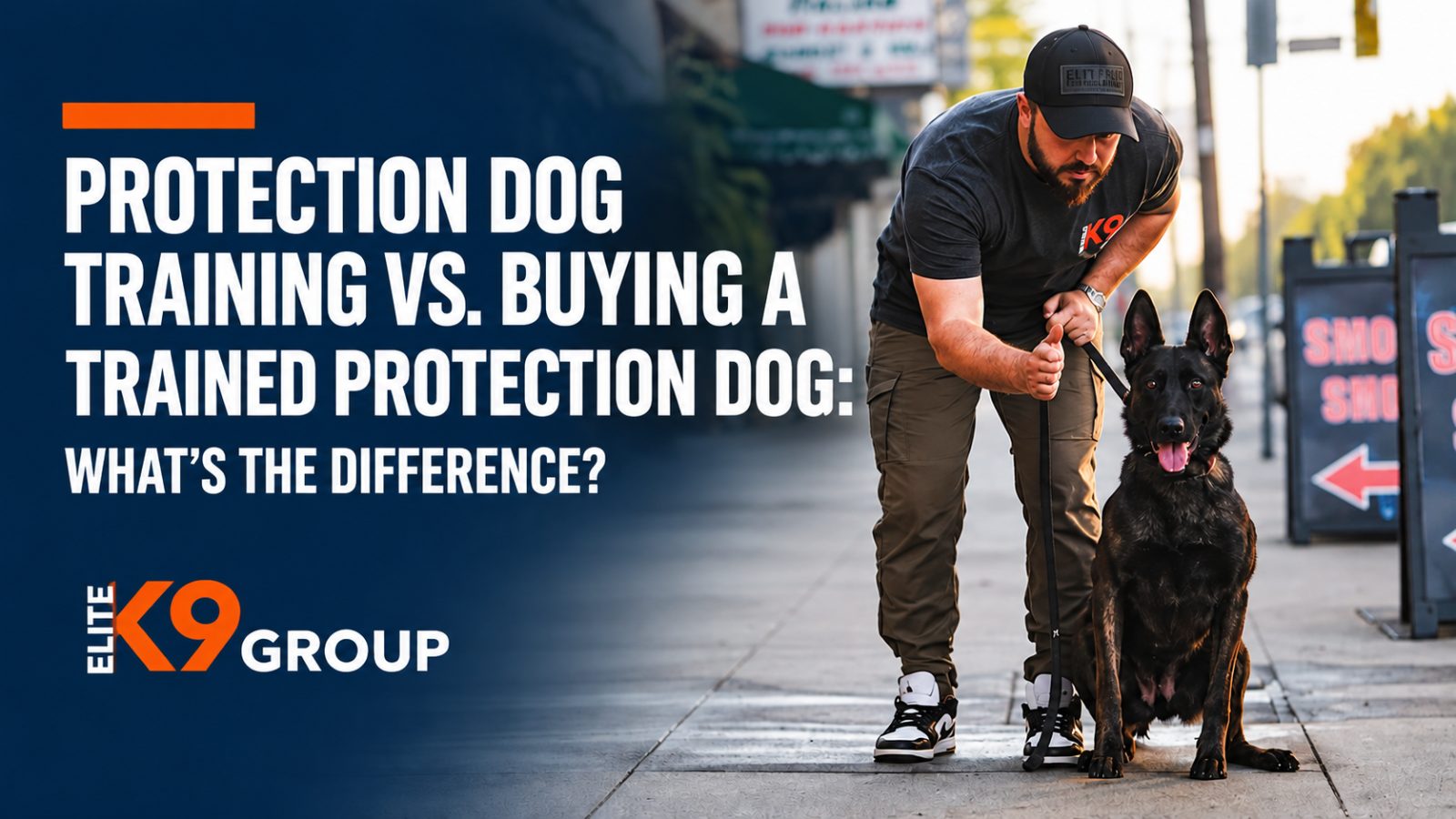
A well-trained protection dog offers more than an intimidating appearance. The right dog combines obedience, confidence, a stable temperament, and the ability to respond appropriately when needed. But if you're considering bringing one into your life, there's an important decision to make: Should you invest in protection dog training or purchase an already-trained dog?
Some owners prefer working with their existing dog through a professional training program. Others search for trained protection dogs for sale because they want a companion with established skills and experience.
Both approaches have advantages, but they differ in cost, time, predictability, and owner involvement.
At Elite K9 Group, we offerprofessional protection dog training in Los Angeles alongside a selection oftrained dogs for sale. Whether you're considering training your current dog or buying a trained protection dog, understanding these differences will help you make a confident, informed decision.
Protection Dog Training vs. Buying a Trained Dog: Quick Comparison
The biggest difference is your starting point. With professional training, you develop the abilities of a dog you already own. When purchasing a trained dog, you select an animal whose training and temperament can already be evaluated.
FactorProtection Dog TrainingBuying a Trained Protection DogStarting pointYour puppy or existing dogAn adult or young dog with established trainingTraining timeMonths or longer, depending on the dogMuch of the initial preparation is already completeInitial costTraining fees paid across programsTypically a larger upfront purchaseTemperamentSuitability must be evaluatedAdult temperament can be assessed before purchaseOwner involvementActive participation throughout developmentHandler transition and continued maintenanceBest suited forOwners committed to developing their dogBuyers seeking established skills and a shorter preparation period
Neither option is automatically better. The right choice depends on the dog's abilities, your lifestyle, and how much time and responsibility you're prepared to invest.
What Is Professional Protection Dog Training?
Protection dog training is a specialized form of canine education that develops controlled protective behavior alongside reliable obedience.
Unlike ordinary obedience lessons, professional protection work requires careful evaluation of a dog's temperament, confidence, health, and behavior.
A protection dog must be capable of following commands consistently, remaining composed around everyday distractions, and responding appropriately to its handler.
At Elite K9 Group, ourprofessional dog training programs include different levels of instruction, allowing training goals to be matched to the individual dog.
Our programs include foundational obedience, advanced K9 training, protection training, and more advanced off-leash work.
For example, our Elite 2 protection level builds on previous training phases and includes controlled protection skills and release commands. Elite 3 progresses toward more advanced obedience and protection performance without a leash.
Depending on the individual dog, professional training may focus on:
- Reliable obedience and recall.
- Confidence in different environments.
- Controlled responses to appropriate protection scenarios.
- Impulse control and disengagement.
- Handler communication and consistency.
- Maintaining calm behavior around people and everyday distractions.
For owners who already have a dog, professional training can be a valuable opportunity to improve obedience while determining whether advanced protection work is realistic.
What Does Buying a Fully Trained Protection Dog Involve?
Instead of developing a dog from the beginning, buying a professionally trained protection dog allows you to select an animal with existing skills.
Fully trained protection dogs have typically completed substantial obedience and specialized preparation before being offered to prospective owners.
Depending on their background, these dogs may already demonstrate strong obedience, environmental confidence, and controlled protection skills.
For people exploring personal protection dogs, purchasing an already-trained dog offers several practical advantages.
You can evaluate the dog's existing abilities, observe its behavior with an experienced handler, and consider whether its temperament matches your household.
This can be particularly helpful for families who want an established adult rather than a puppy whose future suitability remains uncertain.
When reviewing trained dogs for sale, buyers should look beyond breed, size, and appearance.
A professionally prepared protection dog should demonstrate controlled behavior, reliable obedience, and an appropriate response to ordinary situations.
Elite K9 Group offerstrained protection dogs for sale in Los Angeles, including working breeds such as Belgian Malinois and Dutch Shepherds.
Individual availability, experience, and training profiles vary, so reviewing each dog's background is an important part of the selection process.
5 Key Differences Between Training Your Dog and Buying One
1. Training Time and Preparation
Time is one of the most important factors.
Training a dog for protection is not something that can be completed through a few obedience lessons.
A puppy must mature physically and mentally while developing socialization, confidence, obedience, and appropriate behavior around unfamiliar environments.
Advanced protection training comes later, provided the dog demonstrates suitable characteristics.
The entire process can take many months or longer, depending on the dog's age, development, and training goals.
Buying an already-trained protection dog can shorten this preparation period.
However, even an experienced dog needs time to adapt to a new handler and household.
The difference is that you're building skills from the beginning with one option and learning to maintain established skills with the other.
2. Temperament and Predictability
One advantage of purchasing a trained adult is that its temperament is more developed and can be evaluated before making a commitment.
With a puppy, personality and working abilities continue to develop over time.
Even puppies from established working lines may not ultimately be suitable for personal protection.
Professional evaluation helps reduce uncertainty, but it cannot eliminate every behavioral risk.
This distinction is particularly important for owners who want dependable family companions rather than dogs selected primarily for high working drive.
3. Owner Experience and Responsibility
Training your own dog requires ongoing participation.
You may need to attend lessons, practice commands, maintain consistent household rules, and learn how to recognize your dog's responses.
For some owners, this experience is one of the most rewarding parts of developing a protection dog.
Purchasing a trained dog involves a different responsibility.
You must learn how the dog has been trained, understand its established commands, and develop reliable communication.
A skilled dog paired with an inexperienced handler can still experience confusion or inconsistent performance.
Neither option removes the need for continued owner education.
4. Family Compatibility
The dog's ability to live comfortably with your household is just as important as its protective abilities.
Family protection dogs should demonstrate appropriate behavior around visitors, normal household noise, and everyday family activities.
Families with children should prioritize temperament, obedience, supervision, and professional guidance.
A highly driven dog may be excellent at advanced working tasks but may not be the right choice for an inexperienced family.
Buying an adult dog allows you to assess an established temperament, while raising a puppy allows you to participate in its early socialization.
Both approaches require careful matching and responsible ownership.
5. Long-Term Training Maintenance
Protection training does not end when a program is completed or a dog is purchased.
Dogs need continued practice and clear expectations to maintain learned behavior.
A dog that follows commands for a professional trainer may need additional instruction before responding with the same consistency to a new owner.
Whether you train your own dog or purchase a professionally prepared companion, regular obedience practice and appropriate refresher training remain important.
Protection Dog Cost: Is Training or Buying More Expensive?
One of the most common concerns is protection dog cost.
Many buyers assume training their own dog will automatically be cheaper than purchasing an already-trained adult.
However, the comparison is more complicated.
The Cost of Training Your Own Dog
The average cost of dog training varies considerably depending on the location, trainer, program length, training goals, and services provided.
Foundational obedience programs usually involve different requirements from advanced protection training.
When calculating the total investment, consider:
- Temperament evaluations and initial assessments.
- Basic and advanced obedience programs.
- Specialized protection training.
- Private lessons or residential training.
- Training equipment and travel expenses.
- Maintenance lessons and continued practice.
Owners should also consider their own time commitment.
Some dogs may require additional training before advancing, while others may not be suitable for protection work at all.
As a result, starting with a puppy does not guarantee a lower overall investment.
The Cost of Buying a Trained Protection Dog
Purchasing a professionally trained dog generally requires a larger upfront payment.
The price can reflect the dog's selection, care, training, health, age, working background, and level of preparation.
When evaluating security dogs for sale, buyers should ask what is included beyond the dog itself.
For example, will the provider explain the dog's commands? Is handler transition training offered? What health records and training documentation are available?
These details can significantly influence the overall value.
How Much Does a Trained Protection Dog Cost?
There is no universal price.
A dog with foundational obedience and a dog with extensive professional protection training represent different levels of preparation and investment.
Instead of relying on an advertised price alone, request a detailed explanation of the dog's training, temperament, health, and the support included with the purchase.
At Elite K9 Group, prospective clients canrequest a free consultation to discuss training requirements and options.
Trained Protection Dog vs. Puppy: Which Should You Choose?
The trained protection dog vs puppy comparison is especially relevant for first-time owners and families.
A puppy offers the opportunity to participate in early development and establish routines from a young age.
You can guide socialization, build obedience habits, and gradually develop communication with your dog.
However, puppies also require considerable patience.
House training, socialization, chewing, adolescence, and changing behavior are all normal parts of development.
More importantly, not every puppy will develop the confidence and temperament required for advanced protection work.
Buying a trained adult offers greater visibility into the dog's existing personality and abilities.
For owners seeking a shorter route to an established protection companion, this can be a significant advantage.
When Training a Puppy Makes Sense
Training a puppy may be ideal if you enjoy participating in its development, have sufficient time for daily practice, and are comfortable with the uncertainty of future protection suitability.
It can also be rewarding for experienced owners who understand the responsibilities involved in raising working breeds.
When an Already-Trained Dog Makes Sense
Purchasing a trained adult may be preferable if you want to evaluate existing skills, have limited time for the early development process, or need a dog with a more established temperament.
In either case, breed selection and professional guidance matter.
What Are the Benefits of a Trained Protection Dog?
The benefits of a trained protection dog extend beyond the ability to perform specialized protection exercises.
A well-matched, properly trained dog can provide an additional layer of household security while remaining a manageable companion.
Key advantages may include:
Reliable obedience: An appropriately trained dog should respond consistently to familiar commands in a range of practiced environments.
Established behavior: Adult dogs provide more information about their temperament, confidence, and daily habits than young puppies.
Controlled protective skills: Professional preparation emphasizes appropriate responses and handler control rather than indiscriminate aggression.
Compatibility with daily life: A suitable family protection dog should be able to relax at home and participate in ordinary routines.
Reduced initial training time: Purchasing a trained dog means much of the foundational development has already been completed.
These benefits depend on the individual dog's preparation and how effectively the owner maintains its skills.
A protection dog should also be considered one part of a broader approach to personal security, not a substitute for sensible safety measures.
Protection Dog vs. Guard Dog: Understanding the Difference
Another important consideration is the distinction between a protection dog vs guard dog.
Although the terms sometimes overlap, they do not always describe identical responsibilities.
A guard dog may primarily be used to deter intruders or alert people to activity around a particular property.
A personal protection dog is generally expected to work in closer coordination with an individual handler and respond to specific commands.
This is why searching for trained guard dogs for sale does not necessarily produce the same options as searching for professionally trained personal protection dogs.
Some dogs are primarily suited to property deterrence. Others are prepared for controlled handler-directed protection work.
The appropriate choice depends on whether your priority is household companionship, personal protection, property security, or a combination of these goals.
For most families, stability, obedience, and safe everyday behavior should come before intimidating appearance.
What to Look for When Buying a Trained Protection Dog
If you're searching for trained protection dogs for sale, it's important to evaluate the provider as carefully as the dog.
You may encounter advertisements for K9 for sale, family guardians, security dogs, or fully trained personal protectors.
These descriptions can represent very different levels of training and preparation.
Before purchasing, consider the following questions:
1. Can I observe the dog's obedience and temperament?
Ask to see how the dog responds to familiar commands, handles distractions, and behaves in ordinary situations.
2. What protection skills has the dog actually learned?
Training descriptions should be specific. Ask what commands and controlled behaviors the dog has practiced.
3. Is the dog suitable for my experience level?
A dog trained for a highly experienced handler may not be appropriate for a first-time owner.
4. How does the dog behave around family members and visitors?
A dog's suitability should be assessed in relation to your actual household, rather than through a protection demonstration alone.
5. What happens after I bring the dog home?
Ask about handler instruction, integration into the household, maintenance training, and available follow-up support.
An informed purchasing decision should prioritize temperament, training quality, and compatibility—not simply appearance or impressive demonstrations.
Why Choose Elite K9 Group for Protection Dog Training in Los Angeles?
At Elite K9 Group, we understand that selecting the right protection dog involves more than choosing a breed or completing a training program.
Every owner has different expectations, and every dog brings its own personality, abilities, and behavioral history.
Our professional dog training services in Los Angeles include obedience development, behavioral training, puppy foundations, and specialized protection work.
For owners who already have a suitable dog, ourprotection dog training programs provide options for developing obedience and progressing toward more advanced skills.
For buyers who prefer an established companion, ouravailable trained protection dogs provide another path to consider.
We work with clients in Sherman Oaks, Beverly Hills, and communities throughout the Los Angeles area.
Our approach begins with understanding the dog's individual characteristics and the owner's goals.
If you are considering a professional training program, you can also read our guide,Is Board and Train Worth It?, for additional information about structured residential training and owner involvement.
Frequently Asked Questions
Is buying a trained protection dog better than training your own?
Buying a trained dog can be preferable if you want an adult with established skills and a more developed temperament. Training your own dog may be better if you already own a suitable candidate and want to participate in its development. Both options require consistent handling and continued practice.
How long does protection dog training take?
The timeline depends on the dog's age, temperament, previous training, and the level of work required. Foundational obedience may be developed relatively quickly, while advanced protection preparation can take many months or longer. No fixed timeline applies to every dog.
Are fully trained protection dogs safe around children?
Some protection dogs can be suitable for family environments, but no dog is automatically safe around children. Temperament, training history, household compatibility, responsible supervision, and owner education are all essential.
Can I turn my current family dog into a protection dog?
Possibly, but not every dog is suited to protection work. A professional should evaluate your dog's confidence, temperament, health, and behavior before recommending advanced training.
What should I consider before buying a trained protection dog?
Evaluate the dog's temperament, training history, health, compatibility with your household, and the provider's approach to handler instruction. Ask for demonstrations of existing skills and clear information about the dog's limitations.
Do protection dogs need ongoing training?
Yes. Continued obedience practice, consistent commands, and appropriate refresher training help maintain skills and support reliable communication between the dog and its handler.
Final Thoughts: Protection Dog Training or Buying a Trained Dog?
If you already have a dog with suitable characteristics and want to invest in its development, professional protection dog training may be the right choice.
If you would rather start with a dog that has established obedience and specialized skills, buying a trained protection dog may be more practical.
The most important factors are your lifestyle, budget, available time, handling experience, and the individual dog's temperament.
At Elite K9 Group, we offer both options so prospective owners can explore a solution suited to their needs.
Ready to take the next step?
Explore ourprotection dog training programs in Los Angeles, browse ourtrained protection dogs for sale, orrequest a free consultation to discuss your goals.
Elite K9 Group
13238 Riverside Dr, Sherman Oaks, CA 91423