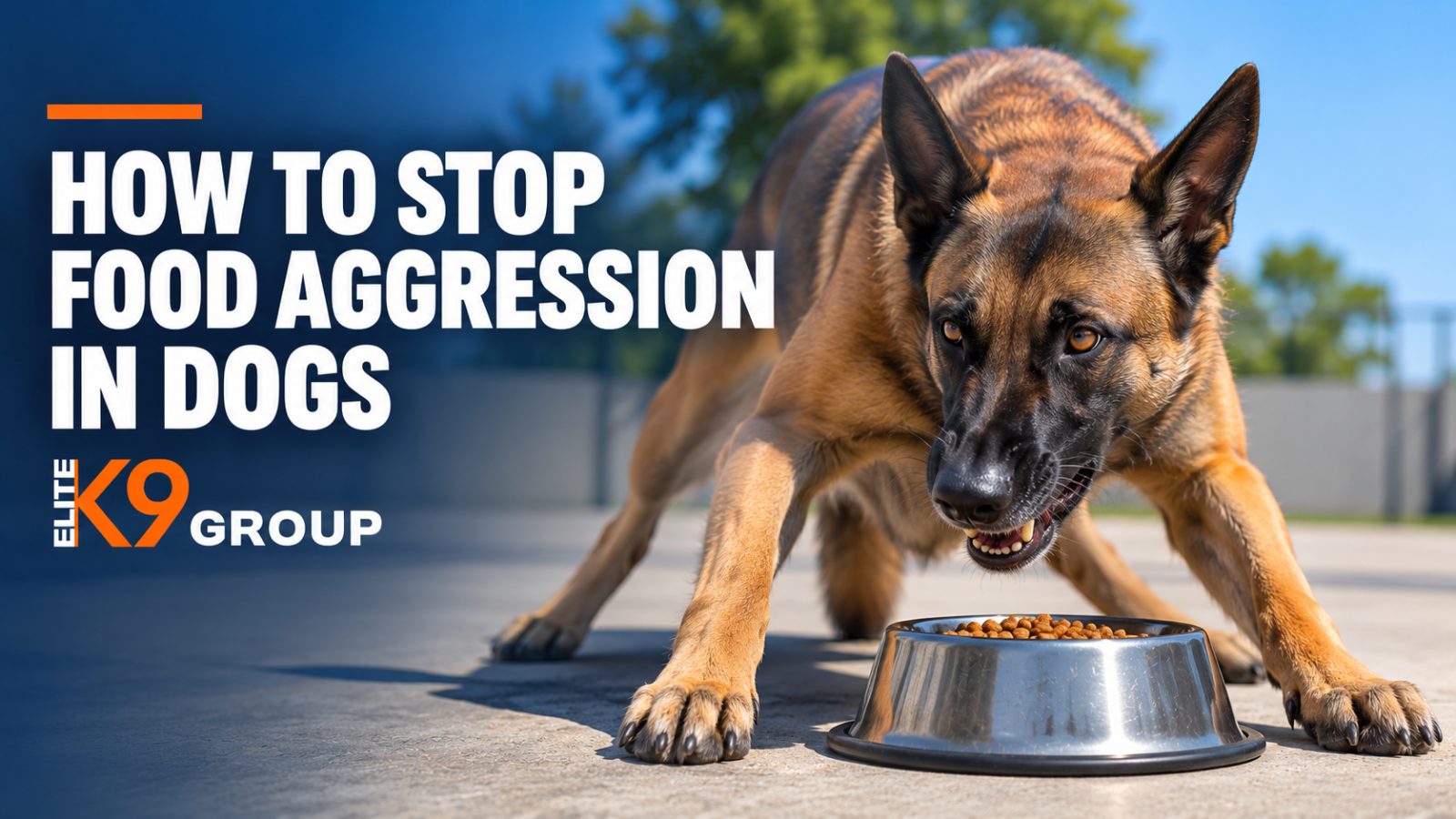
A dog growling over its food bowl can turn an ordinary feeding routine into a stressful situation. At Elite K9 Group, we understand that food aggression is more than an obedience issue. It can involve fear, insecurity, learned behavior, and an instinct to protect valuable resources.
Perhaps your dog freezes when someone walks past its bowl, growls when you approach, or snaps when another pet comes near its food. These reactions can be confusing, especially when your dog is otherwise affectionate and well-behaved.
If you're wondering how to stop food aggression in dogs, the first step is understanding what causes the behavior and why certain attempts to correct it can make matters worse.
In this guide, we'll explain the warning signs of food aggression, practical safety precautions, and why professional dog behavior modification can help owners address resource guarding more effectively.
What Is Food Aggression in Dogs?
Food aggression is a form of resource guarding in which a dog displays defensive or threatening behavior when it believes its food may be taken away.
A dog might stiffen, growl, show its teeth, or snap when a person or another animal approaches its meal.
Some dogs only guard their regular food bowl. Others react when they have treats, bones, chews, or food found around the house.
The behavior can range from subtle discomfort to serious aggression involving biting.
Importantly, food aggression doesn't automatically mean a dog is generally aggressive. Some dogs behave comfortably around people and other animals in most situations but become defensive when valuable food is involved.
However, food guarding should be taken seriously when it creates a safety risk.
Understanding the circumstances behind the behavior is essential before deciding how to manage or modify it.
Why Do Dogs Develop Food Aggression?
Food aggression in dogs can develop for several reasons. There isn't one explanation that applies to every animal.
Fear of Losing Food
Some dogs become defensive because they anticipate that a person or another animal will take their food away.
If someone has repeatedly removed a dog's bowl or interrupted meals, the dog may begin associating approaching people with losing something valuable.
Growling or other defensive behavior can become a way of trying to maintain control of the situation.
Competition With Other Dogs
Dogs living in multi-pet households may become protective of food when they feel that another animal could take it.
This can sometimes occur in puppies that have experienced competition around feeding, but adult dogs can also develop guarding behavior.
Feeding arrangements and interactions between pets can influence how secure each dog feels.
Previous Experiences
A dog's learning history can influence its response to people approaching valuable resources.
Experiences involving food being removed, competition, or stressful interactions may contribute to guarding behavior.
However, owners should not assume that every dog displaying food aggression has experienced neglect or mistreatment.
Individual Temperament and Stress
Some dogs are more sensitive about valuable resources than others.
Environmental stress, unfamiliar visitors, changes in household routines, or increased competition may influence the intensity of guarding behavior.
Pain or Medical Problems
Sudden behavioral changes may sometimes involve physical discomfort or an underlying medical condition.
If your dog unexpectedly begins guarding food or reacting aggressively, a veterinary assessment can help identify possible medical contributors.
The cause matters because an appropriate training plan for one dog may not be suitable for another.
Warning Signs of Food Aggression in Dogs
Food aggression doesn't always begin with growling or biting.
Dogs may display more subtle changes in their body language before their reactions escalate.
Common warning signs include:
- Eating unusually quickly when someone approaches.
- Freezing or becoming rigid over the food bowl.
- Lowering the head or hovering protectively over food.
- Staring intensely at an approaching person or animal.
- Growling or showing teeth.
- Snapping or lunging when someone gets too close.
- Attempting to bite or chasing someone away from food.
These behaviors must be interpreted in context. Eating quickly, for example, does not necessarily mean that a dog is displaying aggression.
A particularly important warning sign is a sudden change from relaxed behavior to stiffness or freezing.
Growling also communicates discomfort. Punishing a dog for growling may suppress that warning without addressing the underlying concern.
Owners who want to recognize these signals more accurately can read our guide tounderstanding dog body language.
Recognizing warning signs early can help prevent dangerous encounters and provide useful information for a professional behavioral assessment.
How to Stop Food Aggression in Dogs Safely
If your dog guards food, the immediate priority is preventing unsafe interactions.
Trying to prove that you can take food away or forcing your dog to accept people near its bowl can increase the risk of aggression.
Although professional dog food aggression training may be necessary to address the behavior, owners can begin with appropriate safety management.
1. Give Your Dog a Quiet Feeding Space
Allow your dog to eat in a calm environment without unnecessary interruptions.
If people frequently walk past the bowl or other animals approach during meals, a quieter feeding arrangement may reduce stressful encounters.
For some households, feeding the dog in a separate room or behind a secure barrier is appropriate.
2. Avoid Taking Food Away as a Test
One common mistake is repeatedly removing a dog's bowl to demonstrate authority.
This can reinforce the expectation that approaching people are a threat to valuable food.
Avoid reaching into the bowl, confronting the dog, or deliberately provoking a guarding response.
3. Keep Children Away From a Guarding Dog During Meals
Children may have difficulty recognizing warning signals and can unintentionally approach a dog too closely.
If your dog displays food guarding, ensure children cannot access the feeding area.
A dog that has growled, snapped, or bitten around food requires particularly careful management and qualified professional assessment.
4. Separate Pets When Necessary
If your dog guards food from other animals, provide separate feeding areas.
Do not expect dogs to resolve food-related conflicts themselves or force them to share bowls.
Appropriate separation can reduce opportunities for threatening encounters while you arrange professional guidance.
5. Avoid Punishment and Confrontation
Yelling, intimidating the dog, using painful corrections, or physically forcing it away from food may increase fear and defensive behavior.
The goal should be to understand and safely address the dog's reaction rather than simply suppress visible warning signs.
6. Arrange a Professional Behavioral Assessment
If your dog repeatedly growls, snaps, or threatens people or other animals around food, consult a qualified professional experienced in resource guarding.
A behavior assessment can help identify the triggers, evaluate the level of risk, and determine whether a structured behavior modification plan is appropriate.
Safe management helps prevent incidents, while professional behavioral guidance can address the underlying problem.
How to Fix Food Aggression in Dogs Without Making It Worse
Many owners search for how to fix food aggression in dogs because they want a straightforward solution.
However, successful behavior modification is not simply about teaching a dog to tolerate having its bowl taken away.
It involves understanding how the dog feels when someone approaches a valuable resource and whether its expectations can be changed safely.
Qualified behavior professionals may use approaches such as desensitization and counterconditioning.
Desensitization involves carefully controlled exposure to a situation at a level the dog can manage.
Counterconditioning aims to change the emotional association connected with that situation.
These approaches require attention to the dog's body language, individual triggers, and safety.
For dogs with a history of snapping, biting, or intense resource guarding, attempting these exercises without professional supervision can be dangerous.
The American Veterinary Society of Animal Behavior recommends reward-based methods and cautions against punishment-based approaches to behavior modification.
Professional guidance is valuable because the intensity and progression of training must be appropriate for the individual dog.
A well-planned approach should focus on creating safer interactions, not forcing the dog to surrender its food through intimidation.
Food Aggression in Puppies: Should You Be Concerned?
Food aggression can also appear in puppies.
A puppy might growl when another puppy approaches its meal, become protective of a chew, or react when someone reaches near its bowl.
Although some guarding tendencies can develop early, these behaviors should not automatically be dismissed as a phase the puppy will outgrow.
Early experiences can influence how a puppy responds to people, animals, and valuable resources.
Appropriate feeding arrangements, predictable routines, and positive experiences are important.
However, owners should avoid repeatedly removing a puppy's food to test whether it will growl.
If your puppy displays persistent guarding, snapping, or increasingly defensive behavior, seek qualified professional advice.
Early assessment may help prevent repeated conflicts and establish safer routines during development.
At Elite K9 Group, we offer puppy development and professional training options. An individual evaluation can help determine which program is appropriate for the puppy's age and behavior.
Why Is My Dog Food Aggressive Toward Other Dogs?
Some dogs guard food from other animals rather than people.
A dog may become tense when another pet approaches its bowl, growl over a chew, or rush to protect food when another animal enters the room.
In multi-dog households, these situations can lead to conflicts and potentially serious injuries.
The safest immediate approach is to prevent competition.
Separate dogs during meals, provide individual feeding areas, and avoid leaving valuable food items where conflict is likely.
Do not force dogs to eat together in an attempt to teach them to share.
If aggression has occurred, professional behavioral assessment is important before attempting closer feeding interactions.
An experienced behavior professional can help determine whether changes to household management are sufficient or whether a more comprehensive plan is necessary.
Why Professional Dog Food Aggression Training Matters
Food aggression can be difficult to address because the visible behavior doesn't always reveal its underlying cause.
Two dogs may growl over food for different reasons, and the level of risk can vary considerably.
This is why professional evaluation is especially important when guarding becomes persistent, intense, or dangerous.
Understanding the Individual Dog
Professional assessment considers the circumstances surrounding the behavior.
A qualified trainer or behavior specialist may examine the dog's feeding routine, previous experiences, interactions with household members, and response to people or animals approaching food.
These observations help identify factors that may be contributing to guarding behavior.
Developing an Appropriate Behavior Modification Plan
A responsible plan should reflect the dog's individual needs and safety risks.
Depending on the situation, professional guidance may involve environmental management, reward-based behavioral work, and carefully controlled changes to the dog's expectations around food.
At Elite K9 Group, ourprofessional dog behavior modification services address challenges including fear-related behavior, reactivity, and other behavioral concerns.
Our training process begins with evaluating the individual dog to better understand its behavior and identify suitable options.
For food guarding involving significant bite risk or complex behavioral concerns, a veterinary behaviorist or another appropriately qualified specialist may be needed.
Helping Owners Manage Feeding Situations
Professional guidance also helps owners understand how their own actions influence the dog's behavior.
This may involve identifying warning signs, organizing safer feeding arrangements, and maintaining consistent management at home.
The goal is not simply to have a dog behave differently during a training appointment.
It is to help the owner understand the problem and follow an appropriate plan in everyday life.
Establishing Realistic Expectations
Some dogs make meaningful progress through appropriate behavior modification.
Others may continue to need specific feeding arrangements and long-term management.
Professional training should not promise to eliminate every form of resource guarding permanently.
Instead, it should aim to reduce risk, support safer behavior, and establish realistic goals for the individual dog.
Common Mistakes When Dealing With Food Aggression
Even well-intentioned owners can accidentally increase tension around feeding.
One mistake is assuming that growling means the dog is trying to dominate the household.
Food guarding is often more accurately understood as an attempt to protect something the dog values.
Another mistake is repeatedly approaching the food bowl to see whether the dog has improved.
Testing a guarding dog's reaction may provoke another incident and does not reliably demonstrate that the underlying behavior has changed.
Some owners also try to correct aggression through punishment, which may increase fear or suppress warning signs.
Finally, waiting until a dog has bitten someone before seeking professional help can create unnecessary risk.
When food guarding becomes persistent or increasingly intense, qualified behavioral guidance is preferable to trial-and-error training.
For a broader explanation of aggressive behavior, read our article onhow to stop dog aggression.
Can Food Aggression in Dogs Be Completely Eliminated?
Food aggression can sometimes improve considerably with appropriate management and professional behavior modification.
However, results depend on the dog's behavioral history, emotional responses, medical condition, severity of guarding, and home environment.
Some dogs become more comfortable around people during feeding.
Others may continue to require quiet feeding spaces, separation from other pets, or additional precautions.
The goal should be safer, more manageable behavior rather than a guaranteed permanent cure.
A professional evaluation can help determine realistic expectations and the most appropriate steps for the individual dog.
When Should You Seek Professional Help?
Consider professional behavioral assistance when your dog repeatedly displays threatening behavior around food.
This is particularly important if your dog:
- Has snapped at or bitten a person or another animal.
- Growls or becomes rigid whenever someone approaches its meal.
- Guards multiple types of food or valuable objects.
- Displays increasingly intense reactions.
- Creates feeding-related conflicts between household pets.
- Lives in a household where children may accidentally approach its food.
If food aggression appears suddenly, arrange veterinary assessment to investigate possible medical causes.
For high-risk cases, a veterinary behaviorist or appropriately qualified specialist may be the most suitable professional to involve.
The sooner serious guarding behavior is appropriately assessed, the sooner owners can establish a safer management plan.
Frequently Asked Questions About Food Aggression in Dogs
How Do You Stop Food Aggression in Dogs?
Begin by preventing unsafe encounters and allowing your dog to eat without unnecessary interference. Avoid taking food away or punishing warning signals. If the dog growls, snaps, or bites, seek qualified professional behavioral guidance. An individualized plan may help address the underlying response while improving safety.
How Do You Break Food Aggression in Dogs?
Food aggression should not be approached as a behavior that must be broken through force or dominance. Punishment and confrontation can make resource guarding worse. Qualified professionals can assess the behavior and use appropriate behavior modification techniques to help the dog develop safer responses.
Why Does My Dog Growl When I Approach Its Food?
Growling may indicate that your dog feels uncomfortable or threatened by your approach. It can be a warning intended to create distance. Avoid challenging the dog or punishing the growl. If the behavior is recurring or escalating, consult a qualified behavior professional.
Can Puppies Grow Out of Food Aggression?
Some puppy behaviors change with development, but food guarding should not be assumed to disappear on its own. Early assessment can help identify contributing factors and appropriate management. If a puppy repeatedly growls, snaps, or guards food intensely, professional guidance is advisable.
Can Professional Dog Training Help With Food Aggression?
Professional behavior modification may help reduce guarding responses and improve feeding-related management. The approach depends on the dog's history, triggers, and level of risk. For severe aggression, a veterinary behaviorist or other qualified specialist may also need to participate in the assessment and treatment plan.
Should I Take My Dog's Food Away to Teach It Not to Guard?
No. Repeatedly taking food away can reinforce the expectation that people approaching the bowl will remove a valuable resource. If your dog guards food, avoid confrontational handling and seek qualified guidance before attempting behavior modification exercises.
Get Professional Help With Food Aggression at Elite K9 Group
Food aggression can turn ordinary feeding routines into stressful situations, especially when owners are unsure how to respond safely.
At Elite K9 Group, we understand that challenging behavior requires more than a generic training technique.
Our professional dog training and behavioral modification services focus on understanding the individual dog, establishing suitable training goals, and helping owners improve communication and everyday behavior.
Whether your dog displays reactivity, fear-related responses, or concerning behavior around valuable resources, our team can discuss your concerns and help you explore appropriate next steps.
Food guarding involving biting or significant risk may also require veterinary assessment or specialist behavioral support.
The first step is understanding the behavior and determining the most appropriate approach for your dog.
Visit Elite K9 Group: 13238 Riverside Dr, Sherman Oaks, CA 91423.
For additional dog training content and updates from our team, followElite K9 Group on Instagram.
Concerned about your dog's behavior around food?
Book Your Free Behavior Consultation to discuss your dog's needs and explore professional training options with Elite K9 Group.